
Oldham County Criminal Court Records
A criminal court record is the case-level file kept by the Office of Circuit Court Clerk after charges are filed in court. In Oldham County, misdemeanors, traffic-related criminal matters, violations, and preliminary felony hearings often appear in District Court first. Felony prosecutions, indictments, felony pleas, felony sentencing, and some appeals from District Court belong in Circuit Court. The same defendant may have early District Court events and later Circuit Court events when a felony moves forward after indictment.
The criminal case file is broader than the charge list. It may include the complaint or citation, indictment or information, arraignment entry, bond order, motions, prosecutor filings, defense filings, plea documents, trial dates, disposition, judgment, sentence, restitution, court costs, probation terms, and later expungement activity. For the narrower arrest-to-charge pathway, use the Oldham County arrest records and court charges page.
Search Oldham County Criminal Cases
The online starting point is Kentucky CourtNet 2.0. Public case search may show the criminal case number, court, defendant, charge entries, hearing events, disposition, and sentence-related docket entries when those fields are public. It should not be described as a full document image portal. Certified criminal court records must be requested from the Oldham County Circuit Court Clerk.
Use the exact case number when it is available.
- Open CourtNet and search by defendant name or case number.
- Use Oldham County and court-type filters when the portal provides them.
- Check whether the case is District Court, Circuit Court, or a transferred felony matter.
- Read the docket entries for charges, arraignment, hearings, pleas, disposition, sentence, and payment events.
- Call the Circuit Court Clerk at 502-222-9837 for certified copies or clerk-confirmed file details.
Kentucky State Police background checks are a separate statewide criminal-history channel. A state criminal-history report is not the same thing as an Oldham County criminal court case file, and a local court record may show docket detail that a background report does not show.
Oldham County Criminal Case Flow
Criminal records change as the case moves. A docket may begin with a complaint, citation, or arrest-linked filing, then add an arraignment, bond order, pretrial hearing, motion, plea, trial date, disposition, and sentence. A felony may start with District Court preliminary activity before indictment moves the case to Circuit Court. Prosecutors may amend, reduce, dismiss, or proceed on charges, and each decision can leave a docket event.
Oldham County users should read the case stage with the court level. District Court may show the first appearance and preliminary activity, but Circuit Court controls the felony case after indictment. Misdemeanor and traffic-criminal matters may remain in District Court through disposition. A docket entry alone may not explain why a case moved, so the case number, court name, and event sequence should be read together.
Case flow: Charges Filed › Arraignment › Pretrial / Motions › Plea or Trial › Disposition › Sentencing
| Stage | What Happens |
|---|---|
| Charges Filed | A complaint, citation, information, or indictment starts the criminal case record. |
| Arraignment | The defendant appears, charges are addressed, and a plea or bond issue may be entered. |
| Pretrial / Motions | The court hears status issues, discovery disputes, bond motions, suppression motions, or continuances. |
| Plea or Trial | The defendant may plead, proceed to trial, or resolve some charges while others are dismissed. |
| Disposition | The court records the outcome for each charge, such as guilty, dismissed, amended, or acquitted. |
| Sentencing | The court imposes jail, prison, probation, fine, restitution, costs, or other terms after conviction. |
What Oldham County Criminal Records Show
The field list below reflects the case information captured in the research for Kentucky public search and clerk records. A single criminal case can have several charges, each with its own status and disposition. The docket should be read charge by charge. A dismissed count, a reduced count, and a conviction can all appear in the same case, so the final judgment or disposition entry matters.
| Field | What It Shows |
|---|---|
| Case Number | The court number used by CourtNet and the clerk for the criminal case. |
| Defendant | The person charged in the criminal case. |
| Court and Division | District, Circuit, Family-related, traffic-criminal, misdemeanor, or felony case placement. |
| Charges | The alleged offenses, statute references, severity level, and later amendments when public. |
| Bond | Release terms, cash bond, surety bond, recognizance, or bond changes if entered. |
| Plea | Guilty, not guilty, conditional, or other plea entries, depending on the case. |
| Disposition | The result for each charge, including dismissed, amended, guilty, acquitted, or transferred. |
| Sentence | Jail, prison, probation, fines, restitution, court costs, or other ordered conditions. |
Charges vs Convictions
Being charged is not the same as being convicted. A charge is an accusation filed in court. A conviction means guilt was found by plea, verdict, or other qualifying court result. Oldham County criminal court records can include charges that were dismissed, amended, reduced, or ended in acquittal, so a searcher should not treat every charge line as a conviction.
Disposition and sentence entries give the best outcome picture. A criminal case may show one count dismissed and another count resolved by plea. It may also show a sentence, probation, restitution, fine, court costs, or later compliance activity. When the outcome is being used for licensing, immigration, employment, housing, or a court filing, the certified judgment or disposition from the Circuit Court Clerk is stronger than an online summary.
| Charge | Conviction | |
|---|---|---|
| Meaning | An accusation filed by complaint, citation, information, or indictment. | A guilty plea, guilty verdict, or qualifying finding of guilt. |
| Timing | Appears early in the case. | Appears after plea, trial, or final disposition. |
| Record Risk | May remain public unless dismissed, sealed, expunged, or restricted. | May carry sentence, costs, probation, and criminal-history consequences. |
Prosecutors and Defense Counsel
Kentucky does not use the District Attorney title. Oldham County charge and criminal case records involve County Attorney and Commonwealth's Attorney functions depending on the charge level. Misdemeanors, traffic, juvenile/status matters, and many preliminary District Court matters often involve the County Attorney. Felony prosecutions after indictment are handled by the Commonwealth's Attorney for the judicial circuit. Public defense is through the Kentucky Department of Public Advocacy when a defendant qualifies for appointed counsel.
The research captured an official-source reference to Oldham County Attorney Berry Baxter at 100 W. Jefferson St. #4, La Grange, KY 40031, phone 502-222-7342, but it also flagged that current prosecutor and DPA service-region details should be verified before prominent use. For that reason, the court-record path should focus on CourtNet and the Circuit Court Clerk rather than treating prosecutor offices as case-copy sources.
Sealed vs Expunged Records
Kentucky law allows some criminal records to be sealed or expunged after the required process. The Kentucky Court of Justice expungement page explains certification steps, and Kentucky State Police publishes links to the major expungement statutes. Expungement is not automatic just because a case was old, dismissed, or eligible. Forms, certification, filing, court review, and agency processing may be required.
| Sealed | Expunged | |
|---|---|---|
| Public Visibility | Hidden from general public view by law or court order. | Removed from ordinary public access after an expungement order is processed. |
| Common Trigger | Juvenile, adoption, safety, mental-health, or case-specific confidentiality rules. | Eligible dismissed, acquitted, no-indictment, misdemeanor, traffic, or Class D felony matters. |
| Kentucky Sources | Confidentiality rules and court orders. | KRS 431.073, KRS 431.076, and KRS 431.078. |
The official Kentucky Court of Justice expungement source is shown in the manifest capture from KCOJ expungement information.
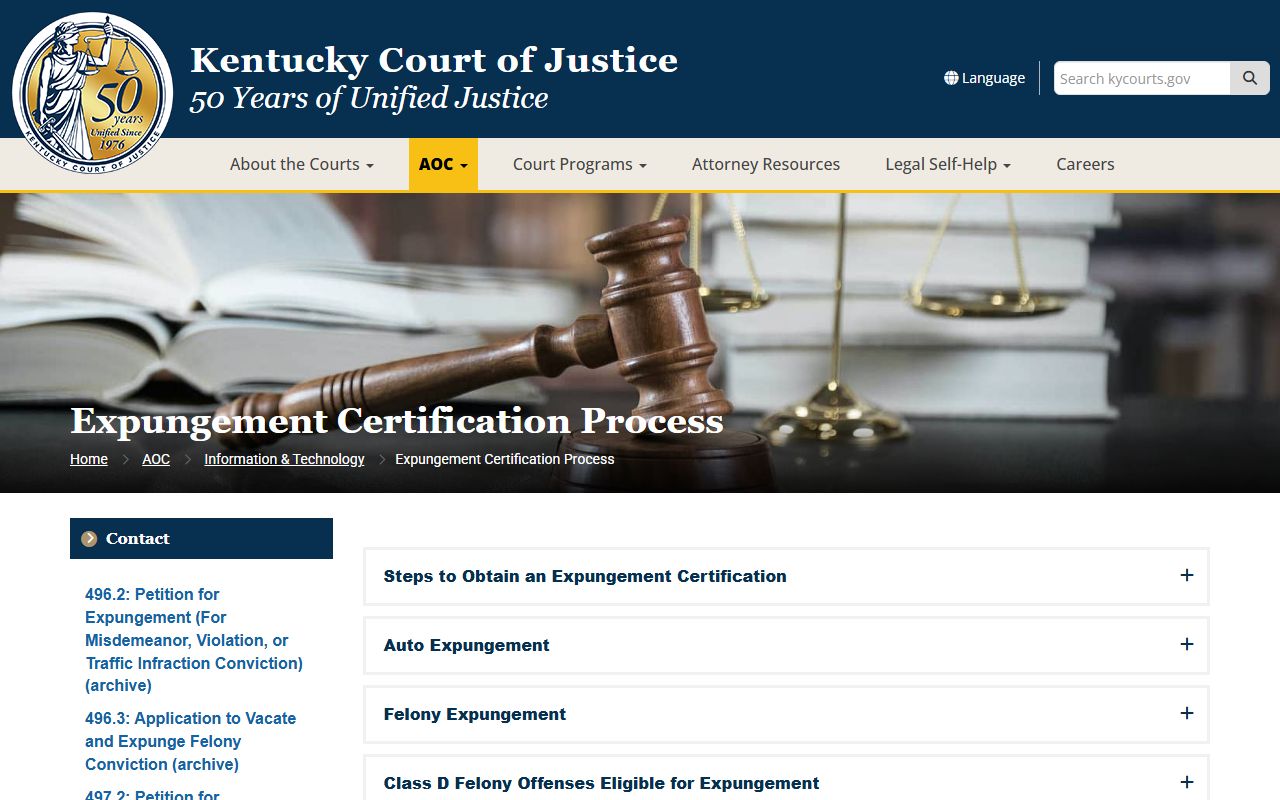
That process affects whether a criminal court record remains visible in normal public search after the court and agencies complete the order.
Public Access to Criminal Records
Kentucky's Open Records Act, including KRS 61.870 to 61.884, supports access to nonexempt public records, while court rules, confidentiality laws, and court orders limit some criminal case materials. Juvenile cases, sealed records, expunged records, protected victim information, mental-health details, and personal identifiers may be restricted or redacted. Public searchers should expect fewer details in sensitive matters.
Kentucky State Police also publishes expungement resources. The manifest source from Kentucky State Police expungements helps connect criminal court records with state-level processing.

State police resources are relevant to criminal-history and expungement processing, but the Oldham case file itself remains a court record.
Key Statutes:
KRS 431.073 covers eligible Class D felony conviction expungement.
KRS 431.076 covers certain dismissed, acquitted, and no-indictment matters.
Restricted Oldham County Criminal Records
Restricted criminal court records include juvenile matters, expunged cases, sealed filings, some mental-health proceedings, protected victim information, and records with personal identifiers. Arrest or booking data can also have public-record limits, especially where safety, juvenile status, or active investigation issues exist. A missing public result does not prove that no case ever existed, and a visible charge does not prove conviction.
The Kentucky legislature page for KRS 431.073 felony expungement is one of the assigned source images for this criminal court records page.
Felony expungement rules are only one part of Kentucky record restriction, so each case should be read with its charge level and disposition in mind.
The companion assigned statute capture is KRS 431.076 dismissed charge expungement.
Dismissed or acquitted charges may still require a formal expungement process before public case-search visibility changes.